Background
Have you been in conversations when you had to give business justification for investment in an API platform or APIs in general?
I have been in such discussions and also interacted with people in the industry who have. When it comes to understanding and articulating the business value of APIs, there is an entire spectrum of people out there. There are people who get it, there are people who don’t get it, and there are people in between.
It’s true that APIs are technology pieces but like everything else in technology, APIs have the greatest impact when they have an associated business value (monetization) which is well understood and received. Trying to do APIs / API programs / API platforms without well articulated business value and buy-in can be painful and frustrating.
Organizations where business value of APIs is understood
Business chases technology folks for APIs.
Organizations where business value of APIs is not understood (but APIs are treated as important technical artifacts)
Technology chases business to get buy-in for APIs.
Does an API have business value only when you charge for API calls?
No. Charging for API calls is one way but not the only way for monetizing APIs. There are many ways you can get business value from APIs.
“ProgrammableWeb holds the view that any time an organization is improving its financial bottom line due to the implementation of APIs — be they internal or external — that organization is essentially monetizing its APIs.” [Reference 1: Guide to API Business Models]
The pitfall to avoid when understanding the business value of APIs is thinking that monetization => charging for API calls.
The rest of the post is inspired by the report [Reference 1: Guide to API Business Models] and looks at numerous other ways APIs generate business value. It’s highly recommended to read the original report in full as this post is intended to only be a summary along with my perspective on it.
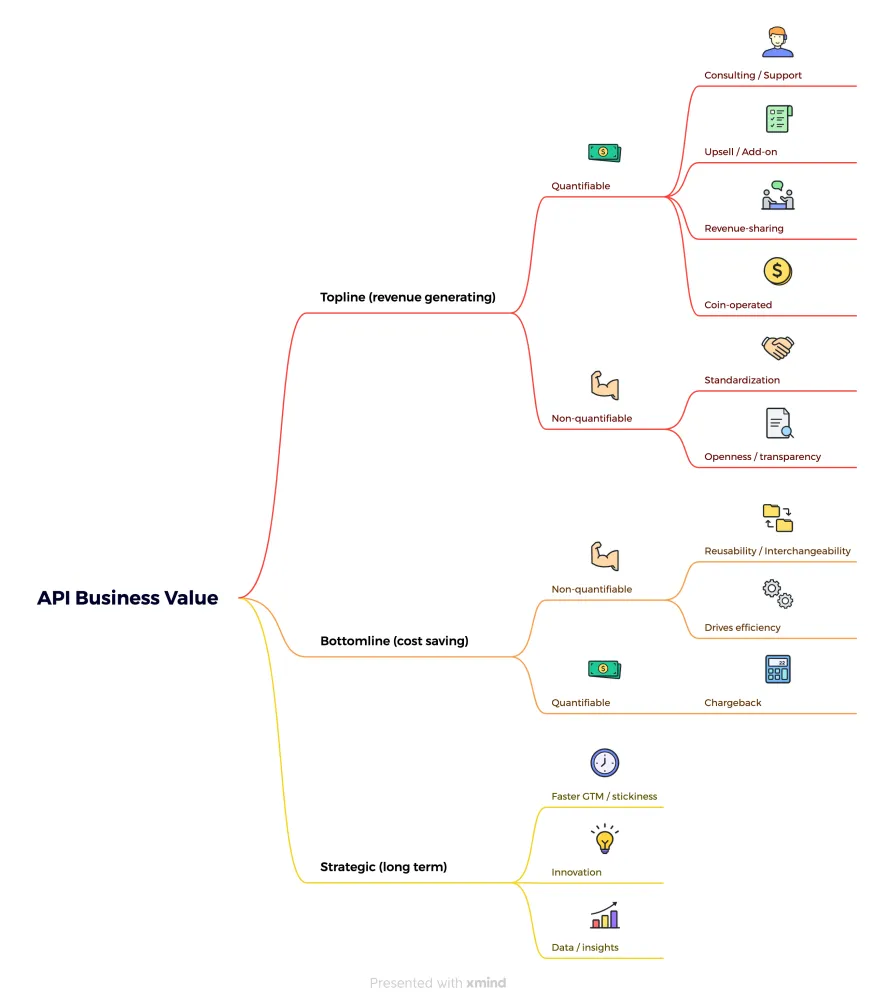
API Business Value
Top-line (revenue generating) → Quantifiable
Consulting / Support
In this models while the APIs are themselves not charged, but consulting and support for it is charged.
Upsell / Add-on
The API access is not enabled by default and needs to be purchased as an add-on. A variation of this model is one where basic APIs are available to all whereas certain advanced APIs are available only to those who pay for it.
Revenue-sharing
The provider makes the APIs available to third parties as a platform who in turn create new applications / value-adds using the APIs. The revenue generated by selling the applications/value-adds are shared between the API provider and app creator. Note: For other variations of the model like resell, affiliate refer to the report.
Coin-operated
The most common way of monetizing APIs by charging for the calls based on a combination of usage attributes. Mentioned here for the sake of completeness.
Top-line (revenue generating) → Non-quantifiable
Standardization
Complying with API requirements/standards which exist due to government mandates or industry consortium is needed to stay relevant in competitive in markets which care about those standards. In such cases the business value of the APIs is not directly quantifiable except as lost opportunity cost for all the instances where lack of APIs closed the business opportunity with an entity altogether.
Openness / transparency
Having APIs signals an open mindset which in turn creates trust. Not having APIs can be a competitive disadvantage especially when the competitor has good quality ones. API support is one of the top requirements for customers / clients when they evaluate different vendors/products. DevOps automation is built on the foundation of APIs.
Bottom-line (cost saving) → Non-quantifiable
Reusable and Interchangeable
Create common reusable assets exposed and discoverable as APIs. Saves cost by not reinventing the wheel every time and makes the implementation interchangeable insulating the consumers of the APIs from such changes.
Drives efficiency
API led delivery of common capabilities drives standardization, reduces learning curve, improves utilization and brings down cost of usage due to amortization and bulk pricing benefits. It also sets the foundation for newfound customer-facing products and services and save time and costs in getting them to the market.
Bottom-line -> Quantifiable
Chargeback
Gives visibility into usage of capabilities across internal consumers and allows for streamlining accounting and cost sharing. It can also help in quantifying the impact and value of the shared capabilities.
Strategic (long term)
Faster GTM + feedback / Greater flexibility / Skin in the game
Releasing capabilities as APIs first instead of GUI, allows teams to test new capabilities without investing too much upfront. APIs also allow consumers to be more self-serviced and not depending on the provider for everything. It’s also ideal for giving generic capabilities and letting customers customize based on their unique needs. Fully baked GUIs is like giving fish. APIs is like giving fishing rod.
One of the lesser acknowledged business value of APIs is that when customers invest in building assets using APIs, they show commitment to the product and have skin in the game. Relying on APIs is a clear indication that they will stick with the product.
Innovation
APIs allow for innovation by using the capabilities in newer contexts or channels of delivery. It also allows for composition and new value and market generation. All of this will impact adoption, active usage and revenue.
Insights / data
Having APIs and analyzing the usage gives wealth of information about who is using it, how they are using it and for what. This can greatly help influence product roadmap and evolution is a data driven way.
Summary (infographic)
Conclusion
-
There are many ways an API can generate business value and it’s not limited to charging for API calls.
-
Some APIs help improve the top-line and some help the bottom-line. Both have business value.
-
Some APIs have strategic importance and may translate into business value over the long-horizon.
-
While an API may have business value it might not always be possible to quantify it. In such cases it will be useful to come up with models to assign an estimated value and weight to them. Not doing this results in treating them as valueless (just because it can’t be easily quantified) and therefore ignoring them in business decisions.
References
[1] Guide to API Business Models
[2] API Business Models: 20 Models in 30 Minutes